






Transthyretine (TTR) is een tetrameer eiwit dat in de lever wordt aangemaakt en dient om thyroxine en retinol in het plasma te transporteren.
Bij patiënten met ATTR kunnen onstabiele TTR-tetrameren door genetische mutaties of de ouderdom uiteenvallen en op een foute manier plooien, waardoor ze amyloïde fibrillen vormen. Die vezels kunnen zich dan in het hele lichaam ophopen in weefsels en organen en een hele reeks symptomen uitlokken.3,7-9

Een systemische aandoening die snel evolueert en levensbedreigend is1,2
ATTR-amyloïdose kan leiden tot ernstige invaliditeit en zelfs fataal aflopen1,3-4
De oorsprong van de ziekte bevindt zich in de lever3,7-9


Kom meer te weten over het ziekteproces van ATTR:
Erfelijke ATTR vs. wild-type ATTR:
De onstabiliteit en het uiteenvallen van TTR-eiwitten kunnen het gevolg zijn van een genetische mutatie, die bekendstaat als erfelijke ATTR-amyloïdose (hATTR), of aan veranderingen die spontaan optreden of te wijten zijn aan leeftijd, dat noemen we wild-type ATTR (ATTRwt).7
Leer meer over de verschillen tussen erfelijke ATTR en wild-type ATTR:


Wereldwijd heeft een groot deel van de patiënten een mengvorm van de ziekte6,13–17
Vaak worden de patiënten gedefinieerd aan de hand van hun hart- (CM) of zenuwsymptomen (PN).
De systemische aard van de ziekte leidt bij veel patiënten tot een gemengd fenotype4,18
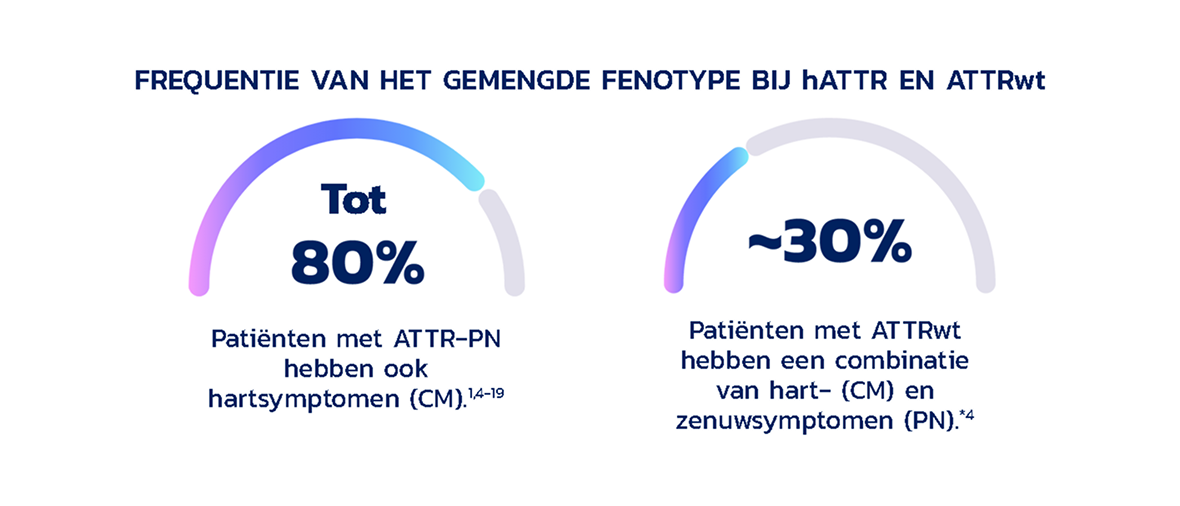

De prevalentie is gebaseerd op gepubliceerde waarden uit verschillende studies die in de hele wereld werden uitgevoerd.


Hebt u vragen?
We zijn tot uw beschikking.
ATTR-CM: Transthyretine-amyloïdose met cardiomyopathie; ATTR-PN: Transthyretine-amyloïdose met polyneuropathie; hATTR: Erfelijke transthyretine-amyloïdose (‘h’ staat voor ‘hereditary’); TTRwt: Wild-type transthyretine-amyloïdose; CM: Cardiomyopathie; PN: Polyneuropathie; TTR: Transthyretine.
Referenties:
- Nativi-Nicolau, J.N., et al., Screening for ATTR amyloidosis in the clinic: overlapping disorders, misdiagnosis, and multiorgan awareness. Heart Fail Rev, 2022. 27(3): p. 785–793.
- Gertz, M., et al., Avoiding misdiagnosis: expert consensus recommendations for the suspicion and diagnosis of transthyretin amyloidosis for the general practitioner. BMC Fam Pract, 2020. 21(1): p. 198.
- Tschöpe, C., Elsanhoury, A., Treatment of transthyretin amyloid cardiomyopathy: the current options, the future, and the challenges. J Clin Med, 2022. 11(8): p. 2148.
- Kittleson, M.M., et al., 2023 ACC Expert Consensus Decision Pathway on comprehensive multidisciplinary care for the patient with cardiac amyloidosis: a report of the American College of Cardiology Solution Set Oversight Committee. J Am Coll Cardiol, 2023. 81(11): p. 1076–1126.
- Hawkins, P.N., et al., Evolving landscape in the management of transthyretin amyloidosis. Ann Med, 2015. 47(8): p. 625–638.
- Witteles, R.M., et al., Screening for transthyretin amyloid cardiomyopathy in everyday practice. JACC Heart Fail, 2019. 7(8): p. 709–716.
- Ioannou, A., et al., RNA targeting and gene editing strategies for transthyretin amyloidosis. BioDrugs, 2023. 37(2): p. 127–142.
- Ando, Y., et al., Guideline of transthyretin-related hereditary amyloidosis for clinicians. Orphanet J Rare Dis, 2013. 8: p. 31.
- Misumi, Y., et al., Recipient aging accelerates acquired transthyretin amyloidosis after domino liver transplantation. Liver Transpl, 2016. 22(5): p. 656–664.
- Kroi, F., et al., Estimating the gender distribution of patients with wild -type transthyretin amyloid cardiomyopathy: a systematic review and meta -analysis. Cardiol Ther, 2021. 10(1): p. 41–55.
- Dohrn, M.F., et al., Diagnostic hallmarks and pitfalls in late-onset progressive transthyretin-related amyloid-neuropathy. J Neurol, 2013. 260(12): p. 3093–3108.
- Griffin, J.M., et al., ATTR amyloidosis: current and emerging management strategies: JACC: CardioOncology state-of-the-art review. JACC CardioOncol, 2021. 3(4): p. 488–505.
- Adams, D., et al., Expert consensus recommendations to improve diagnosis of ATTR amyloidosis with polyneuropathy. J Neurol, 2021. 268(6): p. 2109–2122.
- Planté-Bordeneuve, V., Said, G., Familial amyloid polyneuropathy. Lancet Neurol, 2011. 10(12): p. 1086–1097.
- Swiecicki, P.L., et al., Hereditary ATTR amyloidosis: a single-institution experience with 266 patients. Amyloid, 2015. 22(2): p. 123–131.
- Waddington-Cruz, M., et al., THAOS Investigators. Characteristics of patients with late- vs. early-onset Val30Met transthyretin amyloidosis from the Transthyretin Amyloidosis Outcomes Survey (THAOS). Neurol Ther, 2021. 10(2): p. 753–766.
- Pinto, M.V., et al., Late-onset hereditary ATTR V30M amyloidosis with polyneuropathy: characterization of Brazilian subjects from the THAOS registry. J Neurol Sci, 2019. 403: p. 1–6.
- Gertz. M.A., Hereditary ATTR amyloidosis: burden of illness and diagnostic challenges. Am J Manag Care, 2017. 23(7 Suppl): p. S107–S112.
- Guthrie, S., Improvement in Quality of Life in Patients with Hereditary Transthyretin Amyloidosis with Polyneuropathy and Cardiomyopathy Treated with Inotersen in the Phase 3 Study NEURO-TTR. Heart
Lung, 2020. 49: p. 209–223.
NS ID BE-4106-Revision date 03/2026-WEBLocal code 631
